If you spend even a few days in Messinia, you will hear the words extra virgin olive oil everywhere. It appears on restaurant tables, in family kitchens, in local markets and in conversations about food. In a region where olive trees shape much of the landscape, olive oil is not simply another ingredient. It is part of everyday life.
But what does extra virgin actually mean? And if you are not an olive oil expert, can you really tell whether an oil is good?
To some extent, yes. Official classification depends on laboratory analysis and professional sensory assessment, but ordinary consumers can still learn to recognize many of the characteristics associated with a good olive oil.
The key is to stop thinking of olive oil as something neutral and start tasting it as you would any other food.
What does “extra virgin” actually mean?
Extra virgin olive oil is the highest category of virgin olive oil. It is produced directly from olives using mechanical processes and must meet specific chemical and sensory requirements.
Among those requirements, its free acidity must not exceed 0.8%. It must also be free from sensory defects and show a recognizable fruity character.
This does not mean every extra virgin olive oil tastes the same. Far from it. Some are delicate and soft, while others are intensely green, bitter and peppery. Variety, harvest time, climate, maturity and production methods can all influence the final result.
Can you taste acidity in olive oil?
This is one of the most common misunderstandings about olive oil.
The answer is no.
The free acidity shown on an olive oil analysis is a chemical measurement. It is not the sourness, bitterness or peppery sensation that you experience when tasting the oil.
So if an olive oil feels spicy at the back of your throat, that does not mean it has high acidity.
In fact, that peppery feeling can be one of the positive characteristics of a good extra virgin olive oil.
Learn three important words: fruity, bitter and pungent
When learning how to recognize good olive oil, three words are especially useful: fruity, bitter and pungent.
Fruity
Fruitiness refers to the fresh aromas and flavors associated with healthy olives. Depending on the oil, you may notice notes that remind you of freshly cut grass, herbs, tomato leaves, artichoke, green fruit or riper fruit.
You do not need to identify every aroma perfectly. What matters most is whether the oil smells fresh, clean and lively rather than dull or tired.
Bitter
Bitterness is often misunderstood. Many people assume that a bitter olive oil must be unpleasant or poor quality, but bitterness can actually be a positive characteristic.
It is especially common in oils made from greener, earlier-harvested olives.
The bitterness should feel clean and balanced with the rest of the oil rather than harsh for no reason.
Pungent
Pungency is the peppery or spicy sensation you sometimes feel at the back of your throat after swallowing olive oil.
Some oils are only gently peppery, while others are strong enough to make you cough.
Again, this is not automatically a flaw. It can be part of the natural sensory profile of a fresh, well-made extra virgin olive oil.
Good olive oil does not have to be strong
A common mistake is to assume that the strongest olive oil must automatically be the best.
That is not how olive oil works.
A good olive oil can be mild, medium or intense. What matters more is whether the flavors feel clean, balanced and harmonious.
You may prefer a softer oil for fish or delicate vegetables, while a stronger, greener oil may work beautifully with bread, legumes, grilled meat or salads.
The goal is not always intensity. It is character and balance.
Smell the oil before you taste it
A simple olive oil tasting starts with aroma.
Pour a small amount of oil into a glass. Hold the glass in your palm for a short time so that the warmth of your hand gently releases the aromas. You can cover the top briefly with your other hand, then bring the glass to your nose and smell.
Ask yourself: Does it smell fresh? Green? Herbal? Fruity? Does it remind you of grass, leaves, vegetables or fruit?
You do not need professional vocabulary. Even simply noticing whether the aroma feels fresh and pleasant is a useful first step.
Then take a small sip
Take a small sip and allow the oil to spread across your mouth. Pay attention to the way it changes from the first taste to the finish.
Notice the fruitiness, bitterness, texture and any peppery sensation that appears toward the back of your throat.
Some oils may feel soft and almost buttery, while others may be sharper and more energetic.
The more oils you taste side by side, the easier these differences become to recognize.
Learn to notice when an oil smells tired
You do not need to memorize every official olive oil defect to become a better consumer.
A simpler approach is to ask yourself one question:
“Does this smell fresh or tired?”
Olive oil that has been badly stored or has deteriorated may remind you of stale nuts, old cooking oil, dampness, mold, vinegar or fermented aromas.
If the oil smells flat, stale or unpleasant, something is probably wrong.
Freshness should be one of the first things you notice.
Do not judge olive oil by its color
A bright green olive oil may look impressive, but color tells you surprisingly little about quality.
Olive oil can range from deep green to golden yellow depending on the olive variety, ripeness and other factors.
This is why professional olive oil tasters traditionally use colored tasting glasses that hide the appearance of the oil. They do not want color to influence their judgement.
So when choosing a Kalamata olive oil or any other extra virgin olive oil, do not assume that greener automatically means better.
Your nose and palate are far more useful.
Packaging matters more than people realize
Olive oil has three major enemies: light, heat and oxygen.
All three can gradually damage its aromas and flavors.
This is why dark glass bottles and metal containers generally provide better protection than clear bottles sitting under bright shop lights.
Once you bring olive oil home, store it somewhere cool and dark, away from the stove or direct sunlight, and make sure the container is properly closed after use.
A very good olive oil can lose much of its character if it is stored badly.
Look for useful information on the label
When buying extra virgin olive oil, the label can tell you a lot.
If available, look for information such as the harvest year, producer, olive variety, region of origin and bottling details.
Knowing exactly where an oil comes from can be particularly interesting when exploring Messinia olive oil. Different producers, villages and harvest periods can result in noticeably different styles, even within the same region.
The more transparent a producer is about the oil, the easier it becomes to understand what you are buying.
Does lower acidity always mean better olive oil?
Not necessarily.
You may see producers advertising very low acidity levels, such as 0.2% or 0.3%, and these figures can certainly indicate good handling of the olives.
But acidity alone does not tell you how delicious, aromatic or balanced an oil will be.
An oil with 0.2% acidity is not automatically more enjoyable than one with 0.4%.
Think of acidity as one piece of a much larger picture.
Aroma, flavor, freshness, balance, production and storage all matter too.
Early harvest or ripe olives?
The stage of ripeness at harvest can have a major influence on the taste of olive oil.
Earlier-harvested olives often produce oils with greener aromas, stronger bitterness and more noticeable pungency. Oils made from riper olives may feel softer and show more mature fruit characteristics.
Neither style is automatically better.
They simply offer different experiences.
Someone who enjoys intense olive oil may prefer an early-harvest style, while another person may enjoy something more rounded and gentle.
Why can two good olive oils taste completely different?
Two bottles can both be excellent extra virgin olive oils and still taste nothing alike.
The olive variety plays a role, but so do soil, climate, altitude, harvest date, fruit maturity, milling techniques and storage conditions.
This is part of what makes olive oil tasting interesting.
In Messinia, you may taste one oil that is intensely green and peppery and another that feels softer and fruitier, even though both were produced only a short distance apart.
Instead of searching for one single definition of the “perfect” oil, try noticing what makes each one different.
Try a simple olive oil tasting at home
One of the easiest ways to train your palate is to taste several oils side by side.
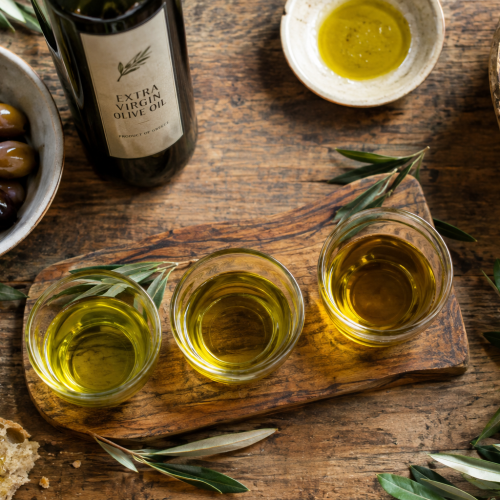
Choose three extra virgin olive oils and pour a small amount of each into separate glasses. Smell and taste them one at a time.
For each oil, pay attention to:
- Aroma
- Fruitiness
- Bitterness
- Pungency
- Texture
- Finish
- Your personal preference
Do not immediately ask which one is “best”.
Instead, ask: “What differences can I actually notice?”
One may smell greener. Another may feel softer. One might have a strong peppery finish while another is more delicate.
Once you begin noticing those differences, olive oil becomes much more interesting than simply something you pour over a salad.
Frequently Asked Questions
Is bitterness in olive oil bad?
No. Bitterness can be a positive characteristic of extra virgin olive oil, particularly in oils produced from greener olives. What matters is how well it fits with the overall balance of the oil.
Why does good olive oil burn my throat?
That peppery sensation is known as pungency. It can be part of the sensory profile of a fresh, high-quality olive oil and is not the same thing as acidity.
Can I taste acidity in olive oil?
No. Free acidity is measured chemically in a laboratory and cannot be directly tasted.
Is greener olive oil better?
Not necessarily. Color can vary naturally between oils and is not a reliable indicator of quality.
What should I look for when buying olive oil?
Look for clear information about origin and producer, good protective packaging, harvest information when available and proper storage. Once opened, keep the oil away from light and heat.
When you are in Messinia, do not simply buy olive oil
Olive oil can tell you much more about a place when you start asking questions.
Who grew the olives? Which variety is it? When were they harvested? Were they picked early or later in the season? How quickly did the olives reach the mill?
These details help explain why one oil may taste grassy and peppery while another feels softer and fruitier.
And in Messinia, where olive trees have shaped the landscape and local food culture for generations, those questions connect the bottle back to the land.
Because a good olive oil is not only something you taste.
It is also the story of where it came from.