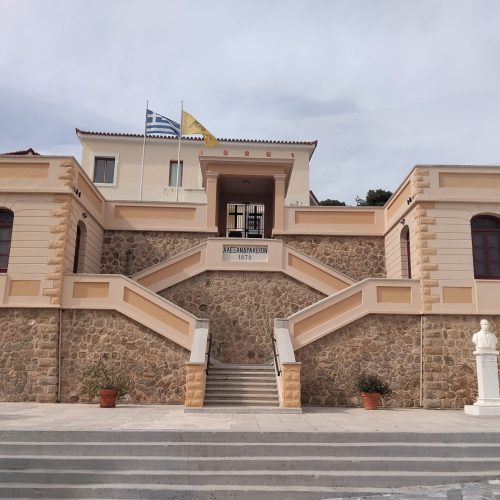
If you want to understand Kalamata, do not begin with the beach.
Begin in the Old Town.
The seafront may be where Kalamata feels most open and modern, but the historic center tells a different story. Here, small streets, old churches, traditional buildings and busy squares reveal the city that existed long before cafés and apartment blocks stretched toward the sea.
It is an area best explored slowly. There is no real need to follow a strict itinerary. Start walking, take the occasional wrong turn, stop somewhere for coffee and allow yourself enough time to notice the details.
Begin at 23rd March Square
A natural starting point is 23rd March Square, one of the best-known places in Kalamata’s historic center.
The square is closely associated with the city’s memory of the Greek War of Independence and remains an important meeting point today. Rather than feeling like an isolated historic monument, it is woven into everyday city life, surrounded by cafés, shops and people passing through.
This mixture of history and ordinary daily life is part of what makes Kalamata Old Town interesting.
Just beside the square stands one of the city’s most recognizable historic churches.
Step inside the Church of the Holy Apostles
The Church of the Holy Apostles is small enough that it could easily be overlooked, especially when compared with much larger churches elsewhere in Greece.
Its importance, however, is far greater than its size suggests.
The church is closely connected with local traditions surrounding the beginning of the Greek Revolution in Kalamata and has become one of the symbols of the city’s historic center.
Even if you are not particularly interested in religious sites, it is worth stepping inside for a few minutes before continuing your walk.
Let yourself wander
From here, resist the temptation to immediately move on to the next attraction.
Some of the most enjoyable parts of Kalamata Old Town are found between the landmarks.
Walk through the smaller streets surrounding the historic center and look beyond the shopfronts. You will find older façades beside renovated buildings, tiled roofs, balconies, courtyards and doors that hint at how the neighborhood has changed over generations.
There are also small cafés, bakeries, local shops and places selling products from around Messinia.
This is the kind of neighborhood where wandering without a particular destination often works better than following a map every few minutes.
Walk up toward Kalamata Castle
Eventually, make your way uphill toward Kalamata Castle.
The walk becomes steeper as you leave the flatter streets of the center, but reaching the higher part of the city gives you a much better sense of Kalamata’s geography.
From around the castle area, you can begin to see how the city developed between the mountains and the sea. The historic neighborhoods sit below, while the newer parts of Kalamata stretch south toward the coastline.
The castle itself has watched over the area for centuries and remains one of the city’s most important historical landmarks.
It is also one of those places where the surroundings are as important as the monument. Spend a little time looking back over the city rather than immediately heading down again.
Continue toward Ypapanti
Not far from the castle is the Metropolitan Church of Ypapanti, another major landmark of Kalamata.
The large church and the open square around it create a very different atmosphere from the narrower streets near the Holy Apostles.
Ypapanti is deeply connected with the religious life of Kalamata, but you do not need to be visiting for religious reasons to appreciate the architecture or the square itself.
It is also a pleasant place to slow down before continuing through the historic center.
Discover a little more of Messinia’s history
If you have time, this part of Kalamata is also the best place to add a museum to your walk.
The Archaeological Museum of Messenia is a particularly natural choice because it helps put what you are seeing outside into a wider historical context. The history of the region stretches far beyond the modern city, and a museum visit can make the rest of your travels around Messinia much more meaningful.
There are also museums and collections focusing on local history, folklore and traditional life.
You do not need to visit all of them in a single afternoon. Choosing one that genuinely interests you will usually make for a much better experience than rushing through several simply because they appear on a sightseeing list.
Kalamata is not only olives
Kalamata is internationally associated with olives and olive oil, but the city’s economic and cultural history is more varied than many visitors realize.
One particularly interesting part of that story is silk.
Kalamata once had an important connection with silk production and weaving, an industry that played a role in the city’s development and local identity.
It is a side of Kalamata that is easily missed if you only think of the region in terms of beaches, olives and summer holidays.
Stop for coffee and watch the neighborhood
At some point during your walk, stop.
Not because you have reached another attraction, but because sitting somewhere is part of experiencing the Old Town.
Find a café around the historic center, order a coffee and spend some time watching the neighborhood move around you.
People meeting friends, locals shopping, conversations drifting between tables and the rhythm of an ordinary afternoon can tell you as much about a city as another monument.
Greek cities are experienced as much through their cafés and squares as through their museums.
Taste something from Messinia
The Old Town is also a good place to start discovering the food of the region.
Instead of simply asking what a restaurant recommends, ask what is local to Messinia.
You may come across sfela, the region’s distinctive cheese, alongside Kalamata olives and local extra virgin olive oil. You might also find lalaggia, thin pieces of fried dough traditionally eaten around Messinia, or syglino, smoked pork that appears in a number of Peloponnesian dishes.
Honey, traditional sweets and other locally produced foods are also worth looking out for.
If something catches your attention in a deli or small food shop, ask where it comes from. In many cases, the answer may lead to a village, farm or producer somewhere else in Messinia that you can visit during your trip.
Take something local home
If you want a souvenir from Kalamata, food is often a better choice than something made specifically for tourists.
A bottle of Messinian olive oil, olives, honey or another regional product carries a little more of the place with it.
Check the label and see where it was produced. Kalamata is surrounded by villages and agricultural areas, and many of the products sold in the city have travelled only a relatively short distance to reach the shelf.
Buying something made locally also gives you another small connection with the region beyond the usual sightseeing.
A relaxed walk through Kalamata Old Town
A simple route could begin at 23rd March Square, continue past the Church of the Holy Apostles, wander through the surrounding Old Town streets and then climb toward Kalamata Castle.
From there, continue toward Ypapanti, before returning downhill toward the archaeological museum and the cafés and food shops of the historic center.
If you are moving quickly, you can see the main sights in around two hours. But Kalamata Old Town is much better when you give it half a day.
That leaves enough time to visit the castle, step inside a museum, stop for coffee and have something to eat without constantly checking the time.
The historic center is easy to explore on foot, although reaching the castle requires a short uphill walk.
And if you only have one day in Kalamata, this is still where we would recommend starting.
Do not just visit Kalamata. Get to know it.
The Old Town is not spectacular because of one enormous monument or one famous street.
Its character comes from everything being close together: churches, squares, old houses, cafés, museums, food shops and people simply going about their day.
Walk slowly enough and you begin to see Kalamata differently.
Not only as a seaside destination, but as a city with its own history, traditions, food and rhythm.
And once you understand that side of Kalamata, the rest of Messinia begins to make a little more sense too.